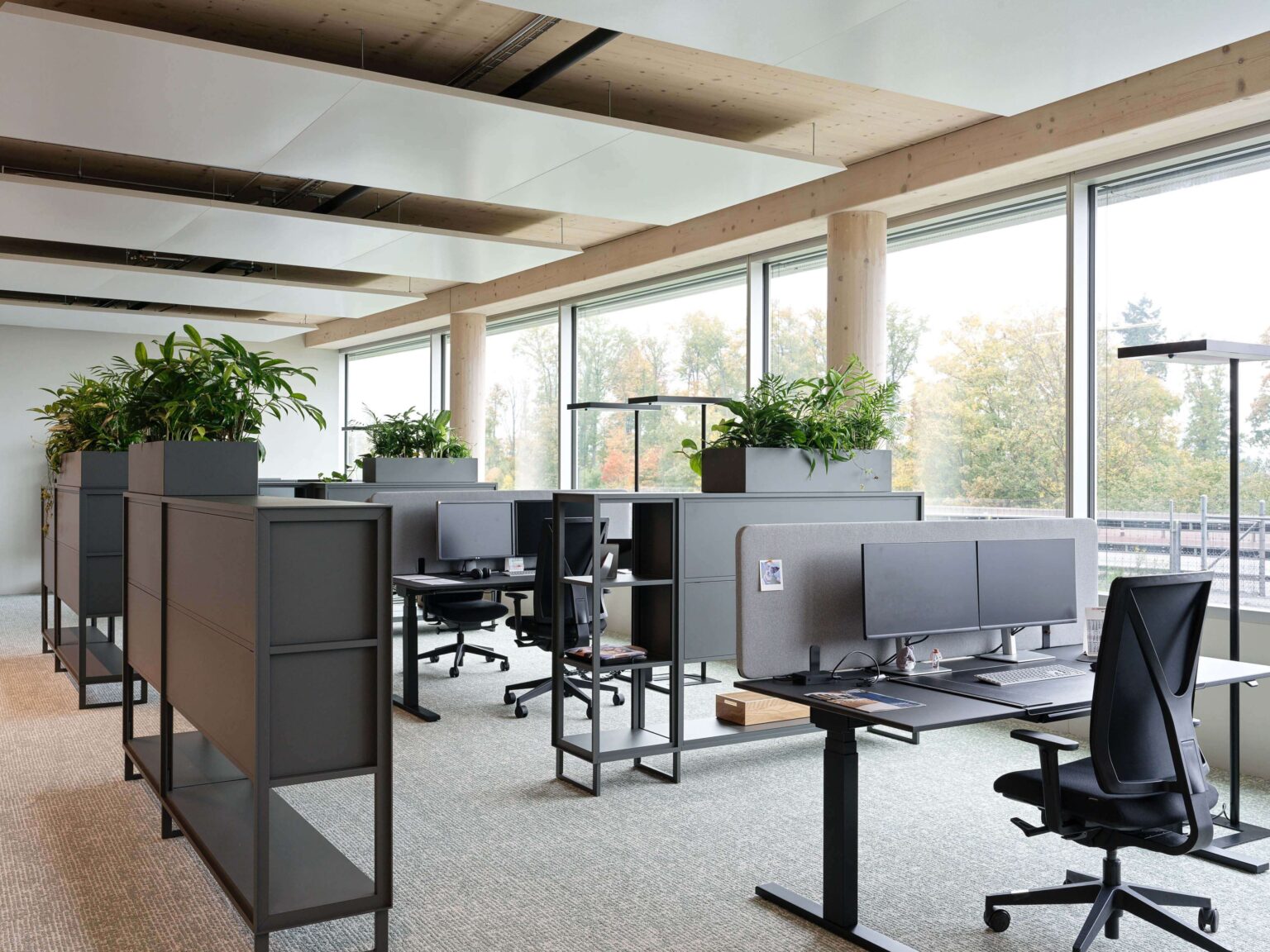
Spaces have an impact. How work environments shape behaviour, culture and collaboration
Spaces are never neutral. They influence how we think, work, communicate and orient ourselves. In conversation with teo jakob, Sandra Gauer, expert in new work environments, architectural psychology and workplace strategy, talks about architectural psychology, modern work environments and why spaces need to do more than offer good design.
Spaces are never neutral
Ms Gauer, what personally fascinates you about the impact of space?
I am fascinated by the fact that spaces are never neutral. They always have an impact, whether they are consciously designed or not. A space sends signals before we process it rationally. It conveys safety or unrest, openness or distance, orientation or overload.
In my work, and also in my book “Architectural Psychology as a Success Factor”, this is exactly what I focus on: making this psychological level visible. Spaces are not only built, furnished or designed. They are read, experienced and used by people.
This impact is often what determines whether a work environment strengthens, connects and activates people or whether it tends to stress, inhibit and separate them.
What happens between people and space, in your view?
A relationship is constantly being created between people and space. We do not perceive spaces only visually. We experience them physically, emotionally and socially.
A space gives us cues about how we should behave. It shows what is desired here, how we should move, whether we should speak, stay, move on or rather hold back.
That is why space is never merely a backdrop. It actively co-creates behaviour. It structures attention, influences communication and shapes the quality of collaboration.
Effectiveness is created through interplay
Which factors make a space effective?
An effective space is never created by one single factor. It is always the interplay. The decisive elements are orientation, proportion, acoustics, light, materiality, smell, furnishing, retreat options and social legibility.
What is particularly important to me is that a space fits its use, its culture and its people. A space can be of high design quality and still fail to become effective if it ignores the actual needs of its users.
Effectiveness emerges where design, psychology, function and cultural context come together.
Why good design alone is not enough
Why is good design alone often not enough?
Good design does not automatically mean good impact. Design can impress, convince aesthetically and create a strong image. But if a space does not provide orientation, does not offer suitable settings or permanently overwhelms people, design quality alone is not enough.
I often say: a space may be beautiful. But above all, it has to be able to do something. It has to support behaviour, translate culture and take people seriously in their diversity.
For me, this is precisely the difference between a beautiful area and a truly effective work environment.
teo jakob perspective:
At teo jakob, we do not understand work environments as a pure furnishing task. What matters is what spaces are meant to achieve for people, culture and collaboration. That is why we always consider spatial concept, furnishing, materialisation and use together.
What still goes wrong in many work environments today?
Many work environments are still shaped too strongly by ideals rather than by real use. Planning is often based on images, trends or concepts that appear modern on paper but are not anchored deeply enough in everyday working life.
Open and flexible work environments in particular are often understood too quickly as the solution. Too little attention is paid to who they actually work for and who they do not work for.
Needs such as orientation, safety, belonging and psychological relief are also frequently underestimated. People need more than options. They need legibility, reliability and spaces in which they can behave appropriately.
The office needs real added value
How has the role of the office changed in recent years?
The office has lost its taken-for-granted status. It is no longer simply the place where work happens because that is where people work. Today, the office has to justify why people should come in.
This shifts its function. It increasingly becomes a place for encounters, identification, cultural anchoring, collaboration, learning and social resonance.
That does not mean that focused work no longer matters. Good work environments have to deliver both: enable exchange while also taking focus, retreat and regeneration seriously.
How spatial design changes behaviour in concrete terms
Can you name an example where spatial design has changed behaviour in a targeted way?
A typical example is the deliberate reorganisation of encounter zones and team areas. When communication spaces do not emerge randomly at the edge, but are strategically embedded in a way that gives them visibility, ease of access and quality of stay, collaboration often changes very clearly.
People start conversations more easily. Silos become more permeable. Spontaneous coordination increases.
At the same time, it is important to note that space alone does not change everything. Impact arises especially when spatial design, leadership, clarity of use and change management work together.
Which small changes often have a big impact?
Often it is not the major structural interventions, but precise adjustments with psychological impact. Better zoning. Clear transitions between focused and communicative areas. Acoustic relief. Retreat spaces that truly deserve the name.
Sight lines, orientation and furnishing that supports behaviour can also change a great deal. A space always communicates what matters here.
When companies emphasise collaboration but only individual workstations are dominantly visible, a contradiction arises. Small changes with a clear message can therefore have a major impact.
Work environments need change, not just furnishing
What do companies underestimate most when they rethink their work environment?
What is underestimated most is that work environments cannot simply be introduced like a new furniture concept. They need to be culturally anchored, supported by communication and understood psychologically. Otherwise, they remain surface.
Many companies also underestimate the complexity of human reactions. Not everyone experiences openness as freedom. Not every reduction of fixed desks is perceived as a gain. Not every modern design automatically creates identification.
This is exactly why every good work environment needs sound workplace change management in addition to strategy and design.
From strategy to furnishing
How do strategy, spatial concept and furnishing interact?
For me, every good work environment begins with a clear strategic question: what should this space achieve for the company and for its people?
Only once this question has been answered can a spatial concept emerge that truly supports behaviour, use and culture. Furnishing is then not the decorative end of a process. It is a central part of the translation.
If the strategic idea is strong but the spatial concept does not reflect it, the project loses impact. If the concept is right but the furnishing does not support the desired use, potential remains unused.
What role do furniture and materialisation play in the impact of a space?
A very significant one. Furniture and materials are not only matters of taste. They influence how a space is read, experienced and used.
Furniture structures behaviour. It guides whether we interact, withdraw, linger or stay only briefly. Materiality, in turn, has a strong atmospheric effect. It appeals to our senses and influences whether we experience a space as high-quality, warm, cool, inviting or functional.
That is precisely why quality in selection and implementation is so important.
What makes successful collaboration between consulting and furnishing partners, in your view?
Good collaboration emerges when both sides share the same ambition for impact. It is not only about filling a space or producing a beautiful result.
What is decisive is a shared understanding of what this work environment is meant to achieve and how strongly the human psyche contributes to it.
I value partners who bring not only products, but also attitude, understanding and genuine interest in how people experience spaces. When consulting, design and furnishing work together as equals, the result is much stronger.
teo jakob perspective:
teo jakob’s strength lies at this interface. We support companies in translating the strategic idea into concrete spaces. From analysis and concept to the selection of the right furnishings. This creates work environments that are not only aesthetically convincing, but also make culture tangible in space.
What do companies gain when they engage consciously with their spaces?
They gain far more than a more beautiful work environment. They gain an instrument that makes culture visible, supports collaboration and stability, provides orientation and makes change tangible.
Well-designed work environments can strengthen identification, support performance and positively influence employee retention.
Above all, they send a clear signal: how a company understands itself, how seriously it takes its people and what form of collaboration it wants to enable. Spaces are therefore also an expression of attitude.
How does the success of well-designed work environments show itself in everyday life?
Success rarely shows itself in one single big moment. It shows itself in everyday life.
In the fact that spaces are used naturally. That collaboration happens more easily. That people know where to go for which activity. That there is less friction. That focused work is just as possible as exchange. That new employees find orientation more quickly.
For me, that is the real benchmark: not the image effect, but the lived effect.
Future-proof work environments
Where will work environments develop in the coming years?
I believe that work environments will need to become more differentiated, more conscious and more psychologically grounded. The era of simple standard models is coming to an end.
Companies will have to understand more deeply that people work, perceive and respond to spaces in very different ways.
At the same time, the office will become even more strongly a place of relationship, culture and identification. It will be less about blanket solutions and more about precise responses to specific organisational and human needs. In my view, the future does not lie in ever more staging, but in greater effectiveness.
What attitude should companies adopt today in order to remain future-proof?
They should have the courage to rethink work not only organisationally or technologically, but also psychologically.
Future viability emerges where companies are prepared to take human complexity seriously. Not superficially, but genuinely.
This also means not treating spaces as a side issue. Anyone who wants to shape transformation has to understand that change is always experienced spatially too. A future-proof attitude connects strategy, culture, leadership, technology and space into one shared understanding of impact.
Personal conclusion
A space that has particularly shaped you, and why?
There are actually several spaces that have shaped me deeply. One of them is the Library of the University of Vienna. I often studied there. Its old, venerable atmosphere triggered something in me every time.
I often had the feeling there of being more focused, clearer and somehow even more intelligent. For me, this was where the power of spatial impact became visible for the first time: a space can activate something in us that goes far beyond function.
A second type of space that has always fascinated me is old churches and temples. I like to retreat there because I experience the impact of space in a very original form. These places have a special density, a calm and an energy that is almost physically tangible.
If you want to experience spatial impact in its purest form, I recommend giving such places time consciously. Space does not always unfold its effect in passing. Some spaces need to be truly allowed to work on us. That is often where their deepest power lies.
teo jakob perspective:
Whether it is a new office space, the further development of existing work environments or targeted adjustments within existing spaces, teo jakob supports companies in thinking strategically about spaces and implementing them effectively.